
- Home
- About Us
-
Training
▼
- Graphics Design
- 3D Animation & VFX
- UI & UX Design
- Interior Design | Architecture
- Civil Engineering
- Mechanical Engineering
- CNC & CAM Engineering
- Mould Design Engineering
- Art CAM Design Engineering
- Electrical Engineering
- Automobile Electric Automation Engineering
- Computer Aided Design Course Content
- Computer Aided Engineering
- Aeronautical Engineering
- Advance Program In MEP
- Advance Program In Composition and Editing
- 3D Scan Reverse Engineering In Product Design
- Gallary ▼
- Blog
- Inquiry
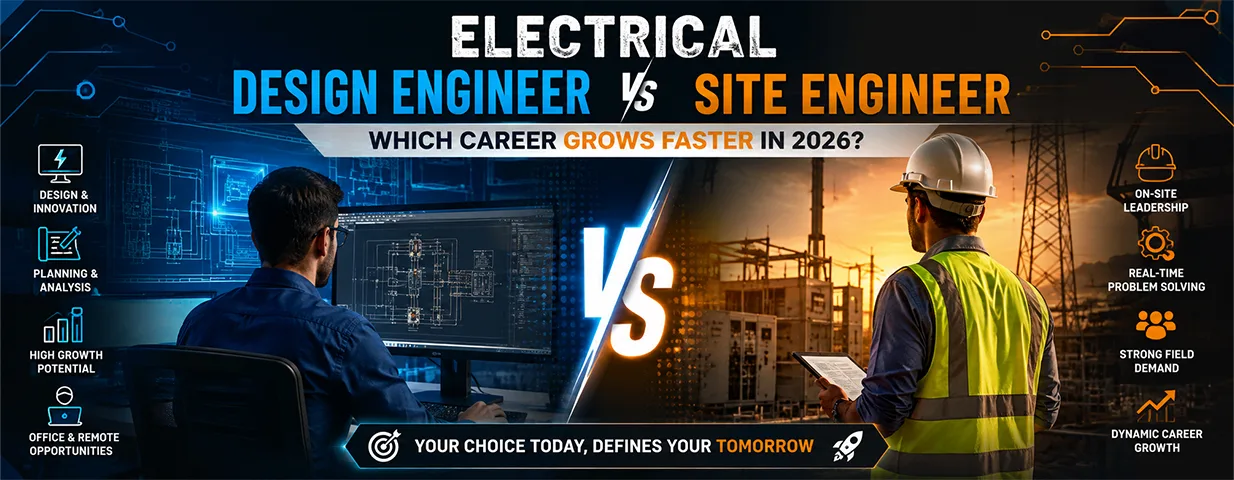
Electrical Design Engineer vs Site Engineer: Which Career Grows Faster in 2026?
If you’re an electrical engineering graduate, diploma holder, or working professional trying to decide between electrical design engineering (drafting panels, SLDs, and layouts on software) and electrical site engineering (executing, supervising, and commissioning projects on the ground), you’re facing one of the most common — and most consequential — career decisions in the electrical engineering field.
This comparison comes up constantly among students choosing a specialization after a diploma or B.Tech in electrical engineering, freshers evaluating their first job offer, and working site engineers considering a switch to design roles (or vice versa). It’s also one of the most searched electrical engineering career questions in India right now — and for good reason, since the two paths lead to very different day-to-day work, skill requirements, and long-term earning potential.
Neither role is universally “better.” Electrical design engineering tends to offer a faster, more predictable growth curve because it’s software-skill-driven, location-flexible, and scales into specializations like panel design, automation, and renewable energy design. Site engineering offers faster hands-on exposure and quicker promotions into project management, but its growth depends heavily on the scale of projects you get placed on. In 2026, design roles are growing faster on average, mainly because India’s EPC, MEP, and renewable energy sectors are digitizing rapidly and design/CAD skills are becoming the entry ticket to higher-paying specializations.
Let’s break down exactly why, what each role pays, what skills each one demands, and which path fits your strengths.
What Does an Electrical Design Engineer Actually Do?
An electrical design engineer works primarily in an office or design studio, translating project requirements into technical drawings and calculations. If you’re researching how to become an electrical design engineer, this is the core job description you’ll be working toward. Typical responsibilities include:
- Preparing single-line diagrams (SLDs), schematics, and panel layouts
- Performing load calculations, cable sizing, and short-circuit studies
- Designing electrical panels, switchgear layouts, and control circuits
- Using software such as AutoCAD Electrical, EPLAN, or Revit MEP
- Coordinating with mechanical, civil, and instrumentation teams during design review
- Preparing Bill of Quantities (BOQ) and technical specification documents
This role is software- and standards-driven. Your output is a drawing or calculation set that other teams — including site engineers — will execute from.
What Does an Electrical Site Engineer Actually Do?
An electrical site engineer works on the project location itself, converting design drawings into a physical, working installation. This role is sometimes listed under titles like site execution engineer, project site engineer, or electrical supervisor. Typical responsibilities include:
- Supervising cable laying, panel installation, and equipment erection
- Coordinating with contractors, vendors, and labor teams
- Conducting testing, commissioning, and safety compliance checks
- Resolving on-site design-to-execution conflicts
- Maintaining project timelines, quality checks, and progress reports
- Liaising with clients and consultants during inspections
This role is execution- and coordination-driven. Site engineers are the reason a design actually becomes a functioning electrical system.
Electrical Design Engineer vs Site Engineer: Side-by-Side Comparison
| Factor | Electrical Design Engineer | Electrical Site Engineer |
| Work environment | Office/studio-based | On-site, field-based |
| Core tool skill | AutoCAD Electrical, EPLAN, Revit MEP | Testing instruments, project tracking tools |
| Day-to-day focus | Drawings, calculations, standards compliance | Execution, supervision, coordination |
| Physical demands | Low | High (site visits, travel, outdoor conditions) |
| Entry barrier | Requires CAD/design software proficiency | Requires practical/on-ground exposure |
| Career ceiling | Design lead, panel design specialist, automation engineer | Project manager, site-in-charge, construction manager |
| Location flexibility | Higher — many design roles allow remote/hybrid work | Lower — tied to project location |
| Skill transferability | High across industries (EPC, MEP, manufacturing, renewables) | High across projects but experience is often sector-specific |
Which Career Grows Faster: A Realistic Look
Why Design Engineering Often Grows Faster
- Digitization is accelerating design demand. India’s push toward renewable energy, industrial automation, and EPC digitization means more companies need engineers who can produce accurate, standards-compliant drawings quickly. Software proficiency compounds — the more tools you master (AutoCAD Electrical, EPLAN, Revit MEP, panel design software), the more specialized and valuable you become.
- Specialization pays. Design engineers who move into niche areas — panel design, switchgear design, renewable energy layouts, or automation/PLC-integrated design — tend to see larger salary increases than in generalist site roles, because these skills are in short supply relative to demand.
- Portability. A strong design portfolio travels well across companies, sectors, and even countries. Site experience is valuable but often tied to the specific scale and type of projects you’ve worked on.
- Remote and hybrid opportunities. Design work is increasingly outsourced or done in hybrid setups, opening access to a wider pool of employers — including consultancies and EPC firms that hire design engineers without requiring relocation.
Why Site Engineering Still Has Strong Growth Potential
- Faster path to leadership. Site engineers who perform well are often fast-tracked into site-in-charge, project engineer, and eventually project manager roles — positions with significant salary jumps and decision-making authority.
- High demand in infrastructure-heavy sectors. India’s ongoing investment in power infrastructure, industrial construction, and EPC projects means site engineers with strong execution track records are consistently in demand.
- Practical credibility. Site engineers build a reputation for solving real-world execution problems — a skill set that’s hard to replicate and highly valued when companies promote from within.
- Multi-skill exposure. Working across electrical, civil, and mechanical coordination on-site often builds broader project management capability faster than a purely design-focused role.
The Honest Verdict
If you’re measuring growth purely by salary trajectory and skill-market demand, design engineering — especially when combined with software specialization — tends to scale faster in 2026, driven by automation, renewable energy, and EPC digitization trends. If you’re measuring growth by speed to leadership titles and on-ground authority, site engineering can outpace design roles, particularly in large EPC and infrastructure companies.
The fastest-growing professionals, in practice, are often those who combine both — starting in either role and deliberately building cross-functional exposure (a design engineer who understands site execution, or a site engineer who can read and modify drawings, is significantly more valuable than someone who stays purely in one lane).
Electrical Design Engineer vs Site Engineer Salary in India: What to Expect
Salary is one of the most searched parts of this comparison, so it’s worth being direct about it — while exact figures vary widely by company, city, project scale, and sector (EPC, MEP, manufacturing, renewables, or PSU), a few patterns hold across most industry salary surveys:
- Entry-level (0–2 years): Pay for electrical design engineers and site engineers tends to start in a similar range, with design roles at smaller firms sometimes starting slightly lower than site roles at large EPC companies.
- Mid-level (3–6 years): This is where specialization starts to matter more than job title. A design engineer skilled in panel design, automation-integrated design, or renewable energy layouts often out-earns a generalist site engineer at this stage — while a site engineer who’s moved into site-in-charge or project engineer responsibilities can out-earn a generalist design engineer.
- Senior-level (8+ years): Design engineers who’ve built deep specialization (switchgear design, EPLAN expertise, renewable/EV-sector design) and site engineers who’ve moved into project management or site leadership both see the strongest salary growth — well above the average for either role taken generically.
- Sector matters more than title. Renewable energy, EV, automation, and semiconductor-adjacent electrical work tend to pay a premium over traditional power-sector roles, regardless of whether you’re on the design or site side.
Because published salary data for these specific job titles varies significantly across sources, treat any number you see as an indicative range — the more reliable signal is sector and specialization, not the design-vs-site label alone.
Skills That Determine Long-Term Growth
For Design Engineers:
- Proficiency in AutoCAD Electrical, EPLAN, or Revit MEP
- Strong grasp of IS/IEC electrical standards
- Load calculation, cable sizing, and short-circuit analysis
- Panel and switchgear design fundamentals
- Ability to read and coordinate with site execution teams
For Site Engineers:
- Ability to interpret and troubleshoot design drawings
- Testing, commissioning, and safety compliance knowledge
- Vendor and contractor coordination
- Project scheduling and reporting
- Working knowledge of the design software used by your project’s design team (this alone significantly boosts promotion speed)
Can You Switch Between the Two?
Yes — and many successful engineers do. A site engineer who invests time in learning AutoCAD Electrical or panel design software becomes a strong candidate for design or hybrid design-coordination roles. Conversely, a design engineer who spends time understanding site execution challenges becomes far more effective at producing “buildable” drawings — a trait project teams value highly. This cross-skilling is one of the most reliable ways to accelerate growth regardless of which path you start on.
Frequently Asked Questions
Which pays more: electrical design engineer or site engineer?
Is electrical site engineering a good career in 2026?
Do I need AutoCAD Electrical to become a design engineer?
Can a diploma holder become an electrical design engineer?
Which role has better work-life balance?
What software skills should an electrical site engineer learn to grow faster?
Is electrical design engineering a good career choice in India in 2026?
How long does it take to become job-ready as an electrical design engineer?
Can an electrical site engineer switch to a design engineering role later?
Which Path Should You Choose?
Choose design engineering if you prefer structured, detail-oriented work, enjoy working with software, and want flexibility in where you can work. Choose site engineering if you prefer dynamic, hands-on environments, enjoy problem-solving under real-world constraints, and want a faster route to project leadership.
Whichever path you choose, building strong electrical design fundamentals — even as a site engineer — gives you an edge that pure specialists often lack. Students and professionals looking to build these fundamentals can explore JM CAD’s Electrical Engineering Course in Ahmedabad, which covers circuit design, power systems, and hands-on lab training relevant to both design and site-execution career paths. For those specifically targeting MEP and site-integration roles, the MEP Course in Ahmedabad covers HVAC, electrical, and plumbing coordination skills used heavily in site execution.