
- Home
- About Us
-
Training
▼
- Graphics Design
- 3D Animation & VFX
- UI & UX Design
- Interior Design | Architecture
- Civil Engineering
- Mechanical Engineering
- CNC & CAM Engineering
- Mould Design Engineering
- Art CAM Design Engineering
- Electrical Engineering
- Automobile Electric Automation Engineering
- Computer Aided Design Course Content
- Computer Aided Engineering
- Aeronautical Engineering
- Advance Program In MEP
- Advance Program In Composition and Editing
- 3D Scan Reverse Engineering In Product Design
- Gallary ▼
- Blog
- Inquiry
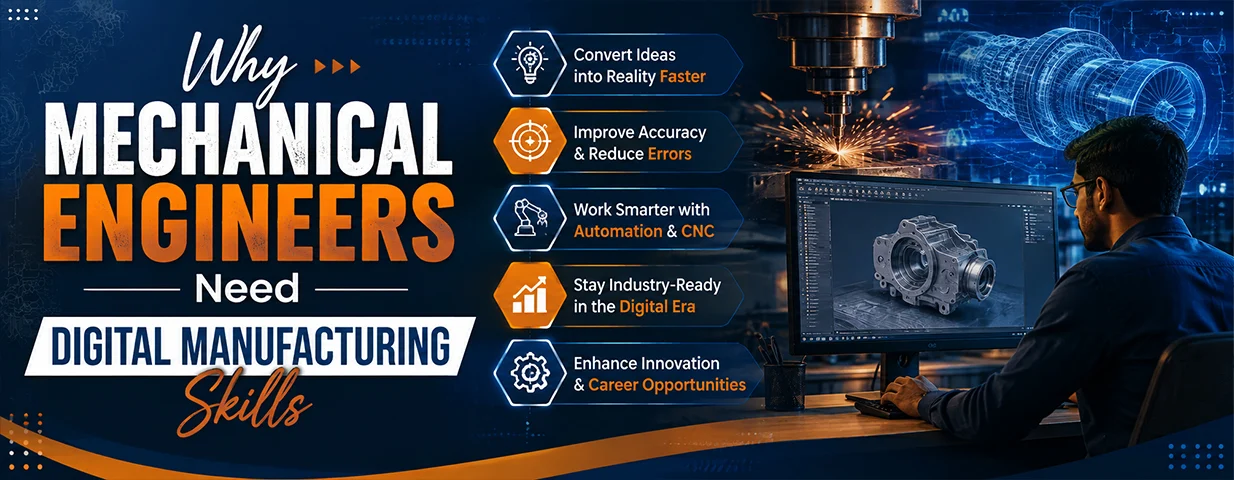
Why Mechanical Engineers Need Digital Manufacturing Skills
A few years ago, a mechanical engineer could build a solid career on drafting and design skills alone — know your CAD software, produce clean drawings, and the rest of the manufacturing process was someone else’s job. That division of labor is disappearing. Factories are digitizing, machines talk to software before they cut a single piece of metal, and the engineers moving fastest into design, production, and R&D roles are the ones who understand the full digital chain — not just the drawing at the start of it.
That shift has a name: Industry 4.0. And for mechanical engineers, it raises a genuinely practical question — which digital manufacturing skills actually matter, and which are just buzzwords?
What "Digital Manufacturing" Actually Means for a Mechanical Engineer
Digital manufacturing isn’t one skill — it’s the connected chain that turns a 3D design into a physical, tested part. For a mechanical engineer, that chain typically breaks down into three layers:
- CAD — designing the part or assembly in 3D
- CAE — simulating and validating that design before it’s ever manufactured
- CAM — converting the validated design into machine-ready toolpaths and G-code for CNC production
Most mechanical engineering graduates learn CAD reasonably well. Far fewer graduate with working CAE and CAM skills — which is exactly why those two areas tend to separate candidates who get hired into design-only roles from those who get hired into roles with real production and R&D responsibility.
Why CAE Skills Matter More Than Most Engineers Realize
CAE — computer-aided engineering — is where a design gets tested before it becomes a real, expensive part. Using finite element analysis (FEA) and computational fluid dynamics (CFD), tools like Ansys let an engineer simulate stress, load, heat, and flow on a design long before a prototype is built.
This matters commercially, not just technically. Physical prototyping and testing are slow and costly; catching a structural weakness or a thermal issue in simulation instead of in a failed prototype saves a company real time and money. Engineers who can run and interpret these simulations aren’t just design contributors — they’re the ones who can defend a design decision with data, which is exactly the kind of engineer that gets pulled into higher-stakes R&D and product development work.
Why CAM and CNC Skills Are the Other Half of the Equation
CAM — computer-aided manufacturing — is where a validated 3D design becomes something a CNC machine can actually cut. This involves generating toolpaths for milling, turning, and multi-axis machining, understanding G-code and M-code, and increasingly, running virtual machine simulations to catch errors before they damage real tooling or stock.
An engineer who understands CAM and CNC programming can do something a pure designer can’t: look at a part and know whether it’s actually manufacturable efficiently, or whether the design needs to change to avoid excessive machining time, tool wear, or scrap. That back-and-forth between design intent and manufacturing reality is one of the most valuable — and most underdeveloped — skills in mechanical engineering hiring today.
Industry 4.0 Skills for Mechanical Engineers: Beyond CAD Alone
Industry 4.0 is often described in abstract terms — smart factories, IoT, automation — but for a working mechanical engineer, it translates into a concrete set of skills:
- Simulation-driven design (CAE/FEA/CFD) instead of trial-and-error prototyping
- CAM-based manufacturing instead of manual machine programming
- CNC and multi-axis machining knowledge, including toolpath optimization and virtual simulation
- Cross-tool fluency — moving a design from CAD through CAE validation to CAM production without losing accuracy at each handoff
- A working understanding of how design decisions affect manufacturing cost and time, not just whether a design “works” on paper
Engineers who build this full chain are the ones equipped to work across automotive, aerospace, manufacturing, robotics, and precision component industries — sectors where design-only skills increasingly aren’t enough to get hired past entry level.
Why This Matters More in Ahmedabad's Engineering and Manufacturing Sector
Ahmedabad and the wider Gujarat industrial corridor have a genuinely strong manufacturing and precision engineering base — automotive components, industrial machinery, and product manufacturing all draw heavily on CNC and CAM-skilled talent. That local demand is exactly why an engineering design institute in Ahmedabad that teaches the full CAD-CAM-CAE chain, rather than CAD in isolation, gives graduates a real edge in the local job market, not just a theoretical one.
The Real Career Question: CAD Alone, or the Full Chain?
Here’s the honest answer most engineers don’t get told directly: CAD alone still gets you an entry-level drafting or junior design job. It does not, on its own, get you into production engineering, R&D, or senior design roles — those require you to demonstrate that you understand what happens to a design after it leaves your screen. Employers hiring for those roles are explicitly looking for the CAE and CAM half of the skill set, because that’s where design decisions actually get validated and made real.
This is why the strongest mechanical engineering training programs are structured around all three layers together — not CAD as a standalone module, with CAM and CAE treated as separate, optional add-ons.
How to Build These Skills the Right Way
Learning CAD, CAE, and CAM as disconnected software modules produces engineers who can operate each tool individually but struggle to move a real project through the full chain. The stronger approach is training that mirrors an actual product development cycle: design a part in CAD, validate it through CAE simulation, then generate and test its manufacturing toolpath in CAM — on real project work, not isolated tutorials.
This is the structure behind JM CAD’s mechanical engineering training in Ahmedabad, which pairs its Mechanical Engineering Design Course with dedicated CAE and Ansys training covering FEA and CFD simulation, and a specialized CNC and CAM programming course covering toolpath creation, G-code, and virtual machine simulation. As an engineering design institute in Ahmedabad, JM CAD structures these as a connected path — CAD to CAE to CAM — rather than isolated certifications, so graduates leave able to take a design from concept through simulation to actual machine-ready production.
Frequently Asked Questions
Do mechanical engineers really need CAM and CNC skills, or is CAD enough?
What is the difference between CAD, CAM, and CAE?
What are Industry 4.0 skills for mechanical engineers?
Where can I learn CNC and CAM training in Ahmedabad?
Is CAE training worth it for a mechanical engineering career?