
- Home
- About Us
-
Training
▼
- Graphics Design
- 3D Animation & VFX
- UI & UX Design
- Interior Design | Architecture
- Civil Engineering
- Mechanical Engineering
- CNC & CAM Engineering
- Mould Design Engineering
- Art CAM Design Engineering
- Electrical Engineering
- Automobile Electric Automation Engineering
- Computer Aided Design Course Content
- Computer Aided Engineering
- Aeronautical Engineering
- Advance Program In MEP
- Advance Program In Composition and Editing
- 3D Scan Reverse Engineering In Product Design
- Gallary ▼
- Blog
- Inquiry
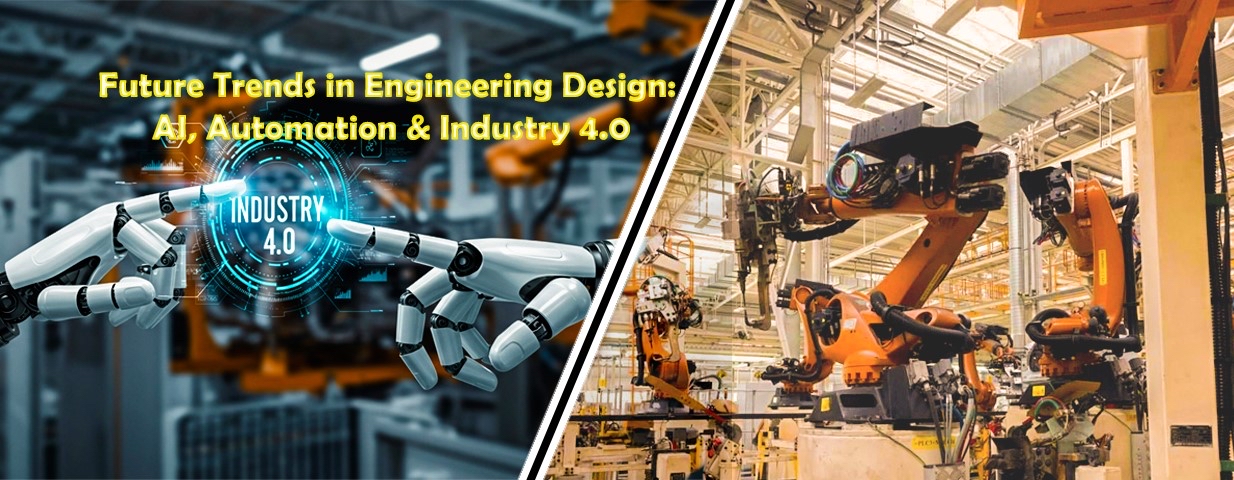
Future Trends in Engineering Design: AI, Automation & Industry 4.0
Engineering design is entering a new era. In 2026, design is no longer limited to drafting or modeling—it has evolved into an intelligent, connected, and performance-driven process. Technologies such as Artificial Intelligence (AI), automation, and Industry 4.0 are transforming how engineers work across CAD, CAE, mechanical, and electrical design disciplines.
Professionals trained at a modern engineering design institute in Ahmedabad are now expected to think beyond drawings and focus on optimization, simulation, and smart manufacturing integration.
AI Is Redefining CAD & CAE Workflows
Artificial Intelligence has become a core component of modern engineering tools. AI-powered CAD software can automatically generate optimized geometries, while CAE simulation tools predict real-world performance before manufacturing begins.
How AI Improves Engineering Design
- Automates mechanical design optimization
- Assists in electrical system layout planning
- Predicts structural and thermal failures
- Reduces design errors at early stages
This shift allows engineers to make faster, data-driven decisions with greater accuracy.
Automation in Mechanical & Electrical Design
Automation is streamlining complex engineering tasks across both mechanical and electrical domains. Parametric modeling and rule-based design systems reduce repetitive work and improve consistency.
Key Benefits of Design Automation
- Faster CAD model creation
- Standardized mechanical assemblies
- Error-free electrical schematics
- Scalable design systems
Automation is now a must-have skill taught in advanced engineering programs.
Industry 4.0: Connecting Design with Manufacturing
Industry 4.0 has blurred the lines between design, simulation, and production. CAD and CAE systems now interact directly with smart factories and digital manufacturing platforms.
Industry 4.0 Design Capabilities
- Digital twins for mechanical and electrical systems
- Real-time data-driven design updates
- IoT-enabled performance monitoring
- Simulation-backed manufacturing decisions
A forward-looking engineering institute in Ahmedabad prepares students to work in these connected environments.
CAD–CAE Integration: Smarter Engineering Decisions
Modern engineering workflows rely on tight integration between Computer-Aided Design (CAD) and Computer-Aided Engineering (CAE). Simulation is no longer a post-design step—it runs alongside modeling.
Engineers validate:
- Mechanical stress and deformation
- Electrical thermal behavior
- Fatigue, vibration, and safety performance
- Manufacturing feasibility
This approach reduces development time, cost, and physical prototyping.
Advanced Engineering Design Techniques for 2026
To stay competitive, engineers must master advanced, future-ready design methods.
High-Impact Techniques
- Generative design for mechanical optimization
- Parametric CAD modeling
- Simulation-driven CAE workflows
- Design for additive manufacturing (DfAM)
- Integrated mechanical–electrical system design
These techniques are now standard in automotive, aerospace, EV, power, and industrial automation sectors.
Career Opportunities Across CAD, CAE, Mechanical & Electrical Fields
As intelligent design systems become mainstream, demand for skilled engineers continues to rise.
High-Growth Roles
- CAD Design Engineer
- CAE Simulation Engineer
- Mechanical Design Engineer
- Electrical Design Engineer
- Industry 4.0 Engineering Specialist
Engineers with cross-domain skills enjoy faster career growth and higher industry value.
Why Engineering Design Skills Matter More Than Ever
Today’s employers seek engineers who can:
- Work across CAD and CAE platforms
- Design integrated mechanical and electrical systems
- Use AI-driven optimization tools
- Support smart manufacturing workflows
Learning these skills at a professional engineering design institute gives candidates a strong competitive edge.
Conversion-Focused CTA (Lead Generation)
Build Future-Ready Engineering Skills
Want to master CAD, CAE, Mechanical, and Electrical design with AI and Industry 4.0 workflows?
👉 Enroll in industry-oriented engineering design programs at a leading engineering design institute in Ahmedabad and gain hands-on training, real-world projects, and career-focused guidance.
What are the future trends in engineering design?
How does AI improve CAD and CAE?
Why is Industry 4.0 important for engineers?
Which engineering fields benefit most from AI and automation?
Are CAD and CAE skills still relevant in 2026?
Conclusion
The future of engineering design is intelligent, connected, and performance-driven. With AI, automation, and Industry 4.0 reshaping CAD, CAE, mechanical, and electrical engineering, professionals must adapt to stay relevant.
Engineers who embrace modern design workflows today will lead innovation tomorrow.